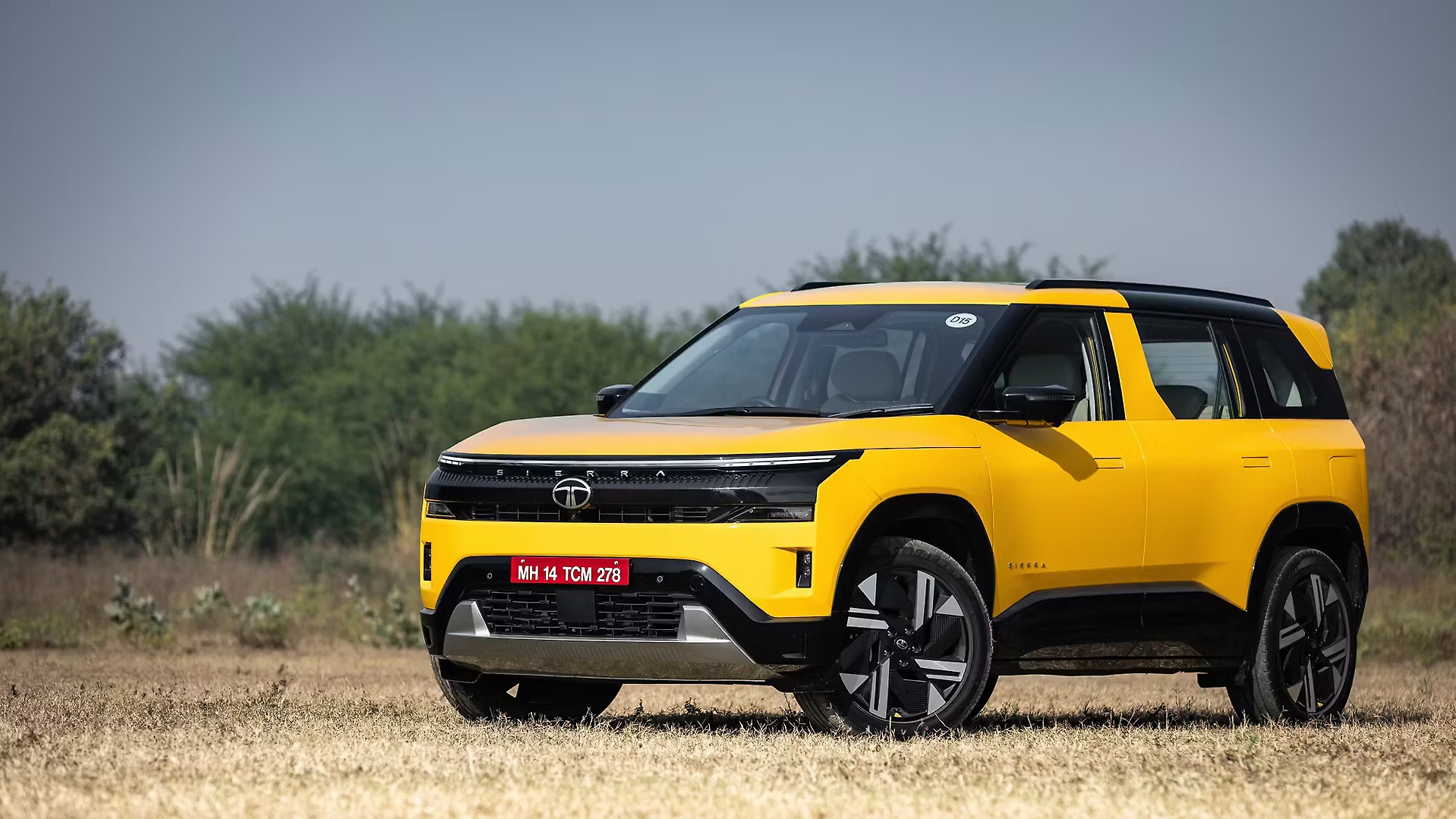
The Tata Sierra is one of those rare cars that arrives with expectations attached to its name. For anyone who remembers the original Sierra from the 1990s, the badge carries plenty of nostalgia. But the new Tata Sierra is not trying to recreate the past. It takes a few recognisable design cues from the original and turns them into a thoroughly modern midsize SUV.
For buyers specifically considering the Tata Sierra Diesel, the proposition is particularly interesting. While petrol engines continue to dominate many urban SUV purchases, a diesel still makes plenty of sense for people who regularly cover long distances. The Sierra combines its 1.5-litre diesel engine with a spacious five-seat cabin, a long list of technology and safety features, and one of the most distinctive designs in its segment.
The Tata Sierra range starts at ₹11.49 lakh ex-showroom, while current listings put the complete range at roughly ₹21 lakh and above at the top end, depending on the variant and source. The diesel versions sit higher than the entry-level petrol variants, so buyers should check the latest variant-specific price with Tata Motors before booking.
So, is the new Tata Sierra Diesel worth buying over established midsize SUVs? Here is a detailed look at its design, interior, features, diesel engine, performance, mileage, comfort, safety and practicality.
Tata Sierra Diesel Design
Design is arguably the strongest part of the new Sierra’s personality.
Tata has managed to reference the original Sierra without making the new SUV look like a retro experiment. The overall shape is upright and boxy, with a high-set bonnet and a substantial road presence. The thick B-pillar and darkened rear glass area are clear visual references to the classic Sierra, while the lighting and detailing bring the design firmly into the modern era.
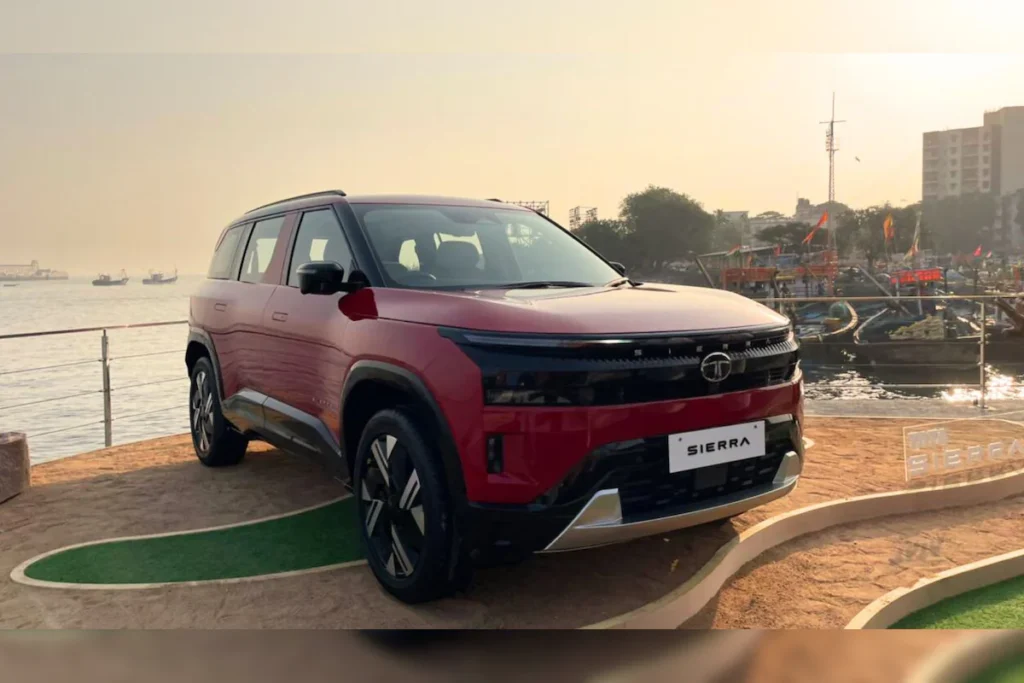
At the front, the Sierra gets a clean and relatively minimalist appearance with slim lighting elements and a blacked-out grille area. The connected LED treatment gives it a wide stance, while the squared wheel arches add some visual muscle.
Move to the side and the Sierra’s proportions become even more interesting. Flush-fitting door handles, large alloy wheels on higher variants and the distinctive glass treatment help it stand apart from more conventionally styled midsize SUVs.
At the rear, the clean bodywork and modern LED lighting continue the same theme. Even the rear wiper has been cleverly integrated beneath the spoiler to maintain a cleaner appearance.
According to Autocar India’s measurements, the Sierra is approximately 4.3 metres long and has a wheelbase of around 2.7 metres. Its substantial width, height and long wheelbase contribute to both its road presence and interior space. Ground clearance is listed at 205 mm, which is useful for dealing with broken roads and typical Indian driving conditions.
There are a few details worth considering. Some of the gloss-black exterior trim could be vulnerable to scratches over time, particularly on a vehicle expected to deal with everyday family use. But purely from a design perspective, the Sierra has something many SUVs struggle to achieve: a recognisable identity.
Tata Sierra Interior and Cabin Experience
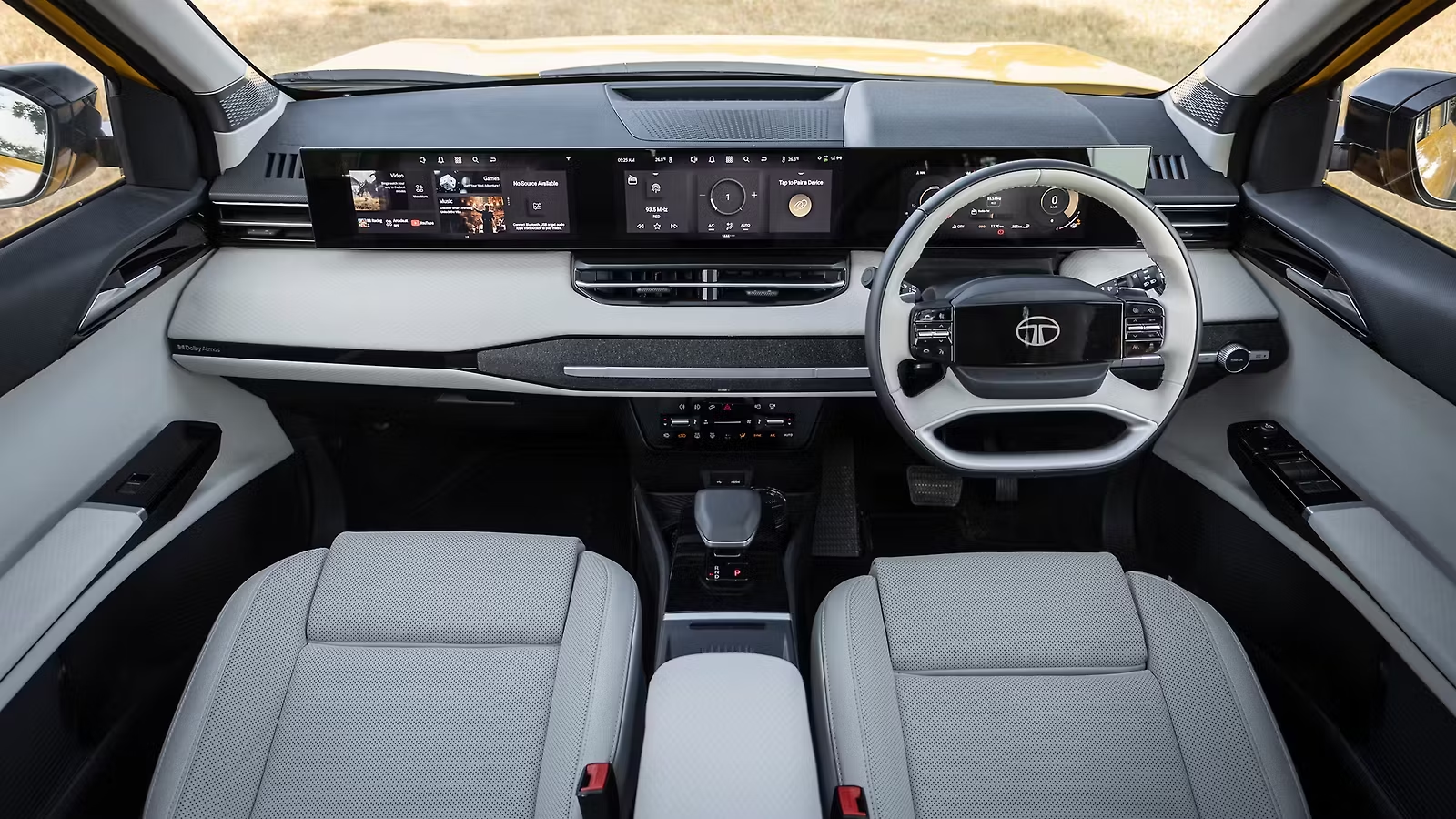
Step inside and the Sierra feels very different from the Tata SUVs of a few years ago.
The dashboard has a modern, horizontal layout dominated by digital displays on higher variants. Depending on the variant, the Sierra offers an elaborate multi-screen setup, with higher versions featuring a 10.25-inch digital instrument cluster and two 12.3-inch displays.
The passenger-side screen is an unusual feature in this segment and gives the cabin a suitably futuristic feel. It is the sort of feature that will attract attention in a showroom, although its everyday usefulness will depend on how often the front passenger actually uses it.
The dashboard materials and overall presentation are more premium than you might expect from a mainstream Tata SUV. The light-coloured interior helps make an already spacious cabin feel even more open.
The centre console provides storage, cupholders, charging options and a wireless charging pad on equipped variants. There is also a modern four-spoke steering wheel with an illuminated Tata logo.
Not everything is perfect. Touch-sensitive climate controls may look sophisticated, but physical buttons are usually easier to operate while driving. Some independent reviews have also highlighted occasional inconsistencies in material quality and fit and finish, so this is something worth inspecting carefully during a showroom visit and test drive.
Overall, however, the Sierra cabin makes a strong first impression and feels suitably special for a vehicle carrying such an important nameplate.
Features and Technology
The Tata Sierra is generously equipped, particularly as you move towards the higher variants.
Depending on the chosen trim, available equipment includes a panoramic sunroof, ventilated front seats, a powered driver’s seat, dual-zone climate control, connected-car technology, wireless Android Auto and Apple CarPlay, wireless smartphone charging, an auto-dimming inside rear-view mirror and rear window sunshades.
The infotainment experience is one of the highlights.
Higher variants offer the multi-screen dashboard arrangement along with a premium 12-speaker JBL Black audio system. Autocar India notes that the system includes a subwoofer, soundbar, Dolby Atmos support and multiple audio modes.
There is plenty here for buyers who prioritise technology. At the same time, the Sierra does not rely entirely on flashy screens to make its case. Practical features such as rear AC vents, charging ports and sunshades are arguably more important during everyday family use.
As always with feature-heavy SUVs, the exact equipment varies significantly between variants. Buyers should compare the official Tata Sierra variant list rather than assuming every advertised feature is available on the diesel version they are considering.
Tata Sierra Diesel Engine and Performance
The Tata Sierra Diesel uses a 1.5-litre four-cylinder turbocharged diesel engine paired with either a six-speed manual or a six-speed automatic transmission, depending on the variant.
Published specifications put output at approximately 118 hp, with torque figures varying between manual and automatic configurations. The diesel is a front-wheel-drive SUV in its current form.
On paper, these numbers are adequate rather than spectacular, and that character appears to carry over to the road.
The Sierra Diesel is not designed to deliver the aggressive mid-range punch some drivers associate with older turbo-diesel SUVs. Instead, the power delivery is relatively linear. This makes the vehicle predictable and easy to drive, but enthusiastic drivers expecting a sudden surge of torque may find it less exciting.
Autocar India’s testing recorded a 0 to 100 km/h time of 12.87 seconds for the diesel version it tested. The publication also found the diesel particularly well suited to highway driving.
The biggest weakness is refinement.
The diesel engine is noticeably noisier than the Sierra’s turbo-petrol option, and vibrations can make their way into the cabin. Road and tyre noise have also been noted by reviewers.
For buyers spending most of their time in heavy city traffic, the petrol automatic may therefore feel smoother and more refined. But for drivers covering significant highway distances every month, the diesel’s torque characteristics and potential fuel economy remain appealing.
The automatic transmission should be especially attractive to buyers who want diesel efficiency without dealing with a clutch in traffic.
Tata Sierra Diesel Mileage and Fuel Efficiency
Fuel efficiency is one of the biggest reasons to consider the Tata Sierra Diesel.
Claimed figures published by automotive sources put Sierra diesel efficiency at approximately 19.2 to 21.26 km/l, depending on the transmission and variant. As always, laboratory or claimed mileage should not be confused with what owners will necessarily achieve in everyday driving.
Real-world testing provides a more useful picture.
In CarWale’s June 2026 test, the Tata Sierra Diesel Automatic returned 12.3 km/l in city conditions and 16.2 km/l on the highway, producing an overall tested figure of 13.27 km/l. Autocar India recorded a similar average of 13.05 km/l in its own real-world testing of the diesel automatic.
Your actual mileage will naturally depend on traffic, driving style, road conditions, load and climate control use.
The key takeaway is that buyers should not purchase the Sierra Diesel Automatic expecting its claimed mileage figure in everyday urban driving. Its efficiency advantage is likely to become more meaningful for people who spend a considerable amount of time on open roads and highways.
Ride Quality, Handling and Comfort
One area where the Sierra performs particularly well is ride quality.
The suspension has been tuned to deal with poor road surfaces without making the SUV feel excessively soft or disconnected. Higher variants use frequency-dependent dampers, and independent road tests have praised the Sierra’s ability to absorb broken surfaces, particularly as speeds increase.
At lower speeds, there can be a degree of firmness, but the overall setup feels robust and well suited to Indian roads.
The steering is relatively light, which helps during city driving and parking. As speeds increase, the Sierra remains predictable, while body roll is reasonably controlled for a tall SUV.
This balance is important because the Sierra is clearly positioned as a family vehicle rather than an outright performance SUV. It needs to be comfortable without feeling cumbersome, and the chassis appears to strike that balance quite effectively.
The 205 mm ground clearance also adds confidence when dealing with large speed breakers, rough roads and poorly maintained surfaces.
Some variants additionally offer terrain modes such as Normal, Wet and Rough, although the current Sierra remains a front-wheel-drive vehicle rather than a traditional four-wheel-drive off-roader.
Rear Seat Comfort and Space
The rear seat is another major Sierra strength.
The long wheelbase translates into generous passenger room, with good knee room, headroom and shoulder space. According to Autocar India’s assessment, the rear bench can accommodate three adults reasonably well, which is an important consideration for families.
Rear passengers can get features such as dedicated AC vents, USB charging ports, window sunshades, a reclining backrest, adjustable head restraints and a fold-down centre armrest.
There is also a boss mode function that allows the rear passenger to create additional space by adjusting the front passenger seat.
The front seats are comfortable as well, with supportive cushioning and extendable under-thigh support available in equipped versions.
For buyers who regularly travel with four or five people, the Sierra’s spacious cabin is one of its biggest advantages.
Tata Sierra Safety
Safety is an increasingly important part of Tata’s brand positioning, and the Sierra comes with a substantial equipment list.
Tata’s official information lists six airbags, while available safety equipment includes electronic stability control, traction control, all-wheel disc brakes, hill-hold assistance and a 360-degree camera system.
Higher variants also offer Level 2+ ADAS. Tata lists 22 ADAS safety functions, with technologies including autonomous emergency braking, adaptive cruise control, lane-keeping assistance and blind-spot-related assistance among the available systems.
The important distinction is between safety equipment and an independently verified crash-test result. Buyers should check the latest Bharat NCAP or Global NCAP records for the exact production model rather than relying purely on manufacturer claims or assumptions based on other Tata vehicles.
On equipment alone, however, the Sierra offers a comprehensive safety package, particularly in its higher variants.
Practicality and Boot Space
The Sierra may look like a lifestyle SUV, but practicality is one of its strongest attributes.
Autocar India measured or reported 622 litres of luggage capacity when loaded to the roof and approximately 450 litres up to the parcel shelf. Folding the rear seats increases available luggage capacity to around 1,257 litres.
The boot opening is wide and the loading lip is relatively low, making it easier to load suitcases and larger items.
Inside the cabin, there are several storage areas for everyday items, although not every storage compartment is perfectly shaped. The centre armrest storage, for example, is relatively narrow and deep.
For a family of four or five, the combination of passenger space and luggage capacity makes the Sierra a genuinely useful road-trip vehicle.
Tata Sierra Diesel Price
The overall Tata Sierra range currently starts at ₹11.49 lakh ex-showroom. Autocar India lists the range extending to ₹21.29 lakh, while CarWale currently lists the top end at ₹21.79 lakh, illustrating why buyers should verify the latest variant-specific pricing before purchase.
The diesel range starts above the entry-level petrol model. Current Autocar listings place the Smart+ Diesel MT at around ₹15.59 lakh on-road in the referenced pricing data, while prices rise considerably as you move towards higher diesel trims and automatic versions. On-road prices vary by city because of registration charges, insurance and local taxes.
This puts the Sierra directly into one of India’s most competitive SUV segments.
The value equation therefore depends heavily on the variant you choose. Lower and mid-spec diesel versions may make sense for buyers focused on space, highway ability and running costs. Once you move towards a fully loaded diesel automatic, the price becomes substantial enough that several larger or more powerful SUVs may also enter the conversation.
Tata Sierra Diesel Pros and Cons
Pros
The exterior design is distinctive and gives the Sierra genuine road presence.
The cabin is spacious, particularly for rear-seat passengers.
Higher variants offer an impressive amount of technology and premium equipment.
The large boot makes it a practical choice for families and long road trips.
Ride quality is well suited to Indian road conditions.
The diesel engine is particularly suited to regular highway use.
Six airbags and an extensive available ADAS package strengthen the safety equipment list.
The combination of modern styling and subtle references to the original Sierra gives the SUV a unique identity.
Cons
The diesel engine is not the most refined option in the Sierra range.
Engine noise and vibrations are more noticeable than in the turbo-petrol version.
Road and tyre noise can enter the cabin.
Real-world diesel automatic mileage is considerably lower than the headline claimed figures, particularly in city driving.
Touch-sensitive controls may not be as convenient as traditional physical buttons.
Some independent reports have raised concerns about occasional fit and finish inconsistencies.
Top variants can become expensive once registration, insurance and other on-road costs are included.
The diesel’s performance is adequate and highway-friendly rather than genuinely exciting.
Tata Sierra Diesel Verdict
The Tata Sierra Diesel succeeds because it offers more than nostalgia.
It is a distinctive midsize SUV with a genuinely spacious cabin, excellent practicality, strong ride quality and an extensive features list. The design gives it an identity of its own in a segment where many SUVs follow increasingly similar formulas.
The diesel version makes the most sense for a specific type of buyer.
If you regularly drive long distances, spend plenty of time on highways and want a spacious family SUV, the Tata Sierra Diesel deserves serious consideration. The manual should appeal to buyers focused on long-term running costs, while the diesel automatic offers greater convenience for those who regularly encounter city traffic as well.
There are compromises. The diesel engine is not as quiet or refined as the Sierra’s turbo-petrol powertrain, and its performance is more relaxed than exciting. Buyers should also keep realistic expectations about fuel economy. Independent testing suggests the diesel automatic can deliver respectable highway efficiency, but real-world city mileage is far removed from the claimed 20 km/l-plus figures.
The Sierra’s biggest strengths ultimately lie elsewhere. It looks different, offers a huge amount of interior space, rides well and feels designed around family use rather than simply chasing specifications.
For high-mileage buyers looking for a comfortable and feature-rich diesel SUV, the Tata Sierra Diesel is a compelling package. If most of your driving involves short urban journeys and refinement matters more than fuel costs, the petrol versions deserve a closer look.
Either way, the new Sierra has achieved something important. It has brought back a famous Tata name without depending entirely on nostalgia to sell the car.
The result is a modern SUV with enough personality to stand on its own.